The contribution of non-network solutions to help manage electricity demand needs will require the development of new market players and industry roles.
Here's a summary of how the future energy system could work with the use of non-network resources.
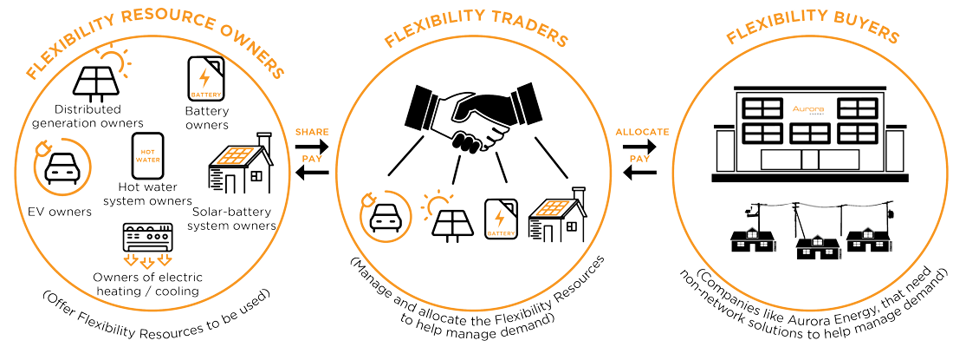
Who does what? Roles and functions
| Flexibility Resource Owners |
Flexibility Service Providers |
Flexibility Buyers |
- Own small energy resources like solar-battery systems, hot water systems, batteries, EV chargers, and heating/cooling systems.
- Control large-scale DER such as batteries, have flexible demand such as dairy customers, irrigation load, cold storage or customers that can shift or reduce loads.
- Can be residential, commercial, or industrial customers.
- Flexibility resource owners and distributed generation companies with energy storage can also be flexibility service providers.
|
- Manage a group of these energy resources to meet network demand.
- Allocate resources to their best use (called "value stacking").
- A flexibility resource owner can also be a flexibility service provider.
- Can be new market entrants or existing retailers.
|
- Companies like Aurora Energy that use these solutions to manage demand and network issues.
- Can also be the Transmission System Operator, Grid owner, or other EDBs.
- Retailers may offer discounts to customers with flexibility resources.
|
