
We know electricity pricing and where lines charges fit in can be confusing. Our Frequently Asked Questions (FAQs) cover everything you need to know about line charges and electricity pricing. Learn how your bill is calculated, why charges vary by region, what discounts and support are available, and what we’re doing to keep prices fair and reliable.
You can find out more about pricing changes from 1 April 2026 here.
Frequently asked questions
We are phasing in the option for retailers to apply 'time-of-use' peak and off-peak pricing for residential customers from 1 April 2024. Time-of-use pricing will encourage people to move their discretionary electricity use such as turning on the washing machine or dishwasher, or charging their electric vehicle, to off-peak, when the network isn't as busy and the prices are lower. The time-of-use pricing impact will be neutral for customers with a typical usage pattern because the higher peak prices will be offset by lower off-peak charges.
This helps us manage demand more efficiently and reduce the need for costly network upgrades. We also want to provide a pricing incentive for new technology users, such as EV owners, to charge during off-peak times, which benefits both customers and the wider network.
The peak periods on our networks are between 7am – 12pm (7 days per week) and 5pm – 10pm (7 days per week). These are longer than most other electricity distributors in New Zealand, because of our colder climate.
Your retailer (who you pay your power bill to) will decide whether to opt-in to our time-of-use prices and how to include these charges on your bill. Many retailers already offer off-peak pricing, so our price signals will complement this.
Watch the video below to find out more about how time-of-use pricing works:
Aurora Energy designs and builds our network to supply the peak demand. The cost to run our network is largely fixed regardless of how much electricity is consumed. The LFC regulations limited the amount of daily fixed charges that line companies like us (and retailers) could charge, meaning that our network costs have had to be recovered from variable charges (how much electricity you use).
Low Fixed Charge Tariff regulations were introduced in 2004 with the aim of reducing power bills for low-use, low-income households. However, they only help some low-use households and have pushed others into greater energy hardship, including many low-income families with high electricity use, for example larger families.
Having more fixed charges means everyone pays their fair share. In line with regulation changes, we will phase out low fixed charges by 1 April 2027. This gives time for households to adjust to the new prices.
You can find out more information here: Phasing-out the Low Fixed Charge Tariff regulations | Ministry of Business, Innovation & Employment (mbie.govt.nz)
As part of the Electricity Networks Association of New Zealand, Aurora Energy contributes to the Power Credit Scheme that was set up to support low-income households struggling with the phase-out of LFC. Please contact your electricity retailer if you think this may apply to you.
Aurora Energy takes power from Transpower’s national grid and distributes it to your place via power lines and underground cables. Our costs are based on making sure our electricity network meets peak demand times when people are using the most power, such as the morning rush and in the evening when people are cooking dinner, heating their homes and getting kids in the bath.
Our line charges are just one part of your power bill, and each retailer (who you pay your bill to) packages up the costs differently. Some combine the costs and others itemise them. Our line charges recover the direct costs of distributing electricity to you across our network (distribution prices), as well as other indirect costs (pass-through prices) including incentives, rates, regulatory levies, and electricity transmission from Transpower’s national grid.
You can find out more about Transpower’s pricing, including their transmission pricing methodology, here: Grid Pricing | Transpower
Our distribution costs make up roughly 35-40% of your power bill. This graph shows the national average for how your power bill is split.
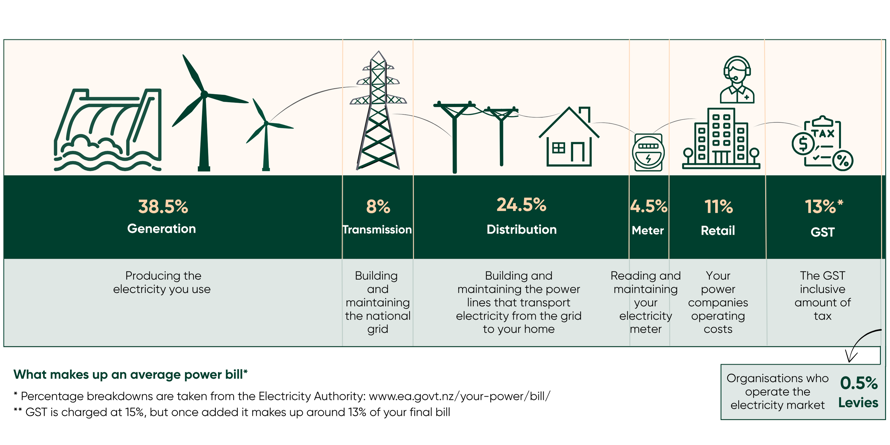
We often get asked how Aurora Energy’s line charges compare with other areas. Prices in the Dunedin and Queenstown Lakes areas are around the national average. Central Otago/Wānaka prices are higher than the national average. This is because there are fewer people on this network, and it also covers a large area.
Aurora Energy has three pricing areas: Dunedin, Central Otago/Wānaka and Queenstown Lakes. Please see below a breakdown of the line charge component of your power bill, depending on which pricing area you live in. You can find out more about how Aurora Energy sets pricing (pricing methodology) and our pricing roadmap here.
The average monthly bill for a Residential connection consuming 9000kwh of energy per year in different pricing areas is shown in the pie charts below. Please note this only shows the proportion of lines charges.
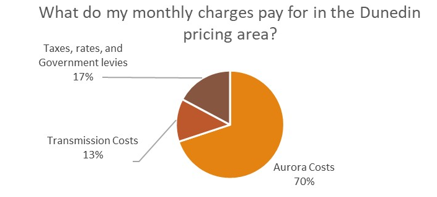
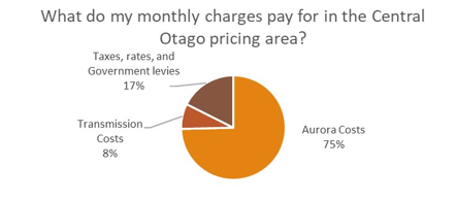
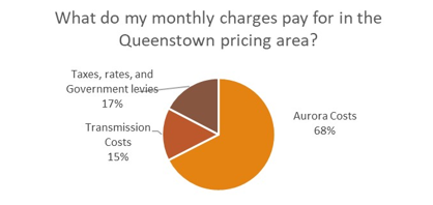
There’s an advantage to living close to a dam because your transmission charges will be lower – these are Transpower’s costs to get the electricity from the hydro dams to the grid exit point (where the power flows from the national grid to Aurora Energy’s distribution network). However, this is offset by these areas being less densely populated, meaning our distribution costs to service fewer customers are higher.
We offer controlled supply discounts to customers who let us manage things like their hot water during peak times on the network (known as ripple control). In the future we hope to extend this to discounts for other things like electric vehicles and storage batteries.
The Commerce Commission decides how much revenue we can earn by making sure we only receive revenue that reflects the costs of operating and maintaining the network. This is the same for all electricity distribution companies in New Zealand.
The Electricity Authority decides how much of that revenue is paid by customers, by setting guidelines for how prices are structured and what pricing approaches can be used.
You can find out more about how Aurora Energy sets electricity distribution prices here.
We are mindful of the cost impact to customers, especially on low-income households. Before setting prices/line charges, we model the impact on low-income households and we do our best to balance those impacts with the need to invest in a safe and reliable network.
Aurora Energy’s role is electricity distribution, however we’re often asked about how customers can save money on their bill. If you’d like to compare your power bill, head to 'Billy' (managed by the Electricity Authority) or 'Powerswitch' (managed by Consumer NZ) for a free and independent check.
For tips and tricks on how to lower your power bill, check out our Energy saving tips page,
The Electricity Retailers Association of New Zealand (ERANZ) has developed a resource to assist you if you are having trouble paying your power bill.
It outlines support available across a range of services, including from your retailer, such as the EnergyMate Coaching Programme, and options to pre-pay your bill. It also covers government-funded programmes like the Warmer Kiwi Homes programme, the Healthy Homes initiative, Winter Energy Payments, and Emergency Grants, as well as community and phone support, information on energy efficiency and savings, and your rights as a consumer.
You can access the resource on the ERANZ website here. Having trouble paying your power bill? - ERANZ | Electricity Retailers' Association of New Zealand
Future price increases are likely to be driven by the need to invest in infrastructure to support increasing electrification. We review our investment plans annually to ensure that the timing is right. We don’t want to invest too soon and place additional costs on our customers, and we don’t want to invest too late and risk our customers not having the electricity they need when they need it.
In addition, we are looking at non-infrastructure solutions that will reduce the costs of electricity distribution. We were the first distributor in the country to do this with a solar/battery solution in the Upper Clutha area and we are looking at ways of extending that into other parts of the network.